How six million Parisians ended up in the Catacombs of Paris
The bones under Denfert-Rochereau were never meant as a sight for visitors. They were the answer to two problems Paris faced in the late 18th century, a city sinking into its own quarries and cemeteries too crowded to use. This page follows the story in order, without the legends.
Stone for the city, holes beneath it
Much of old Paris is built from a pale limestone lying close under the Left Bank. Geologists call it Lutetian limestone, after Lutetia, the Roman name for the city. Quarrymen dug it out from the Middle Ages onward.
At first they worked open pits. As the city spread over the workings, the digging went underground, following the stone in long galleries held up by pillars of rock left standing. Over the centuries the tunnels reached under whole districts.
The old workings run for roughly 300 km (about 185 miles) beneath Paris. The network of former mines dwarfs the small stretch that visitors walk today.
When the streets began to fall in
By the 1770s the abandoned galleries had become a real danger. Stretches of road above old quarries collapsed, and houses went down with them. Nobody could treat the holes as somebody else's problem any longer.
In 1777 the crown created the Inspection Générale des Carrières, a service charged with mapping the quarries and shoring them up. Its workers built walls and pillars under the streets. Carved street names and dates still mark some galleries on the visitor route.
A cemetery nobody could use any more
Above ground, Paris had a second problem. The Cimetière des Innocents, near today's Les Halles, had taken the dead of many parishes for centuries, and it was badly overcrowded.
Neighbors complained about the smell and about damp seeping into nearby cellars. After years of protest the cemetery was closed, and the authorities had to find somewhere to put what it held.
The answer lay south of the old city. The quarries under the Tombe-Issoire area were empty and already being reinforced. They sat close to the toll gate called the Barrière d'Enfer, well away from the crowded center.
Moving the bones by night
From 1786 the remains were dug up from the Innocents and carted south. The transfers took place at night, and at the quarries the bones were tipped down shafts into the galleries below.
Other parish cemeteries in Paris were emptied the same way over the following decades. Altogether the ossuary holds the remains of roughly 6 million people. Every guide and listing repeats that figure.
Almost none of those people can be named. Plaques underground give the cemetery each section came from and the date of its transfer, which is about as personal as the record gets.
The 6 million figure is an estimate built from old cemetery records, not a count of skulls. Read it as an order of magnitude rather than a precise number.
Walls of skulls and long bones
At first the bones lay in heaps. The tidy arrangement that visitors photograph came later, under Louis-Étienne Héricart de Thury, who ran the quarry service in the early 19th century.
His teams stacked the long bones into walls and set rows of skulls into them as bands and patterns. Behind those neat faces, the rest of the remains lie loose, piled deep into the galleries.
He also added plaques carrying verses and quotations, most of them about death and the passing of time. Many are in French or Latin, so a guide who translates them adds a great deal to the walk.
The doorway that tells you to stop
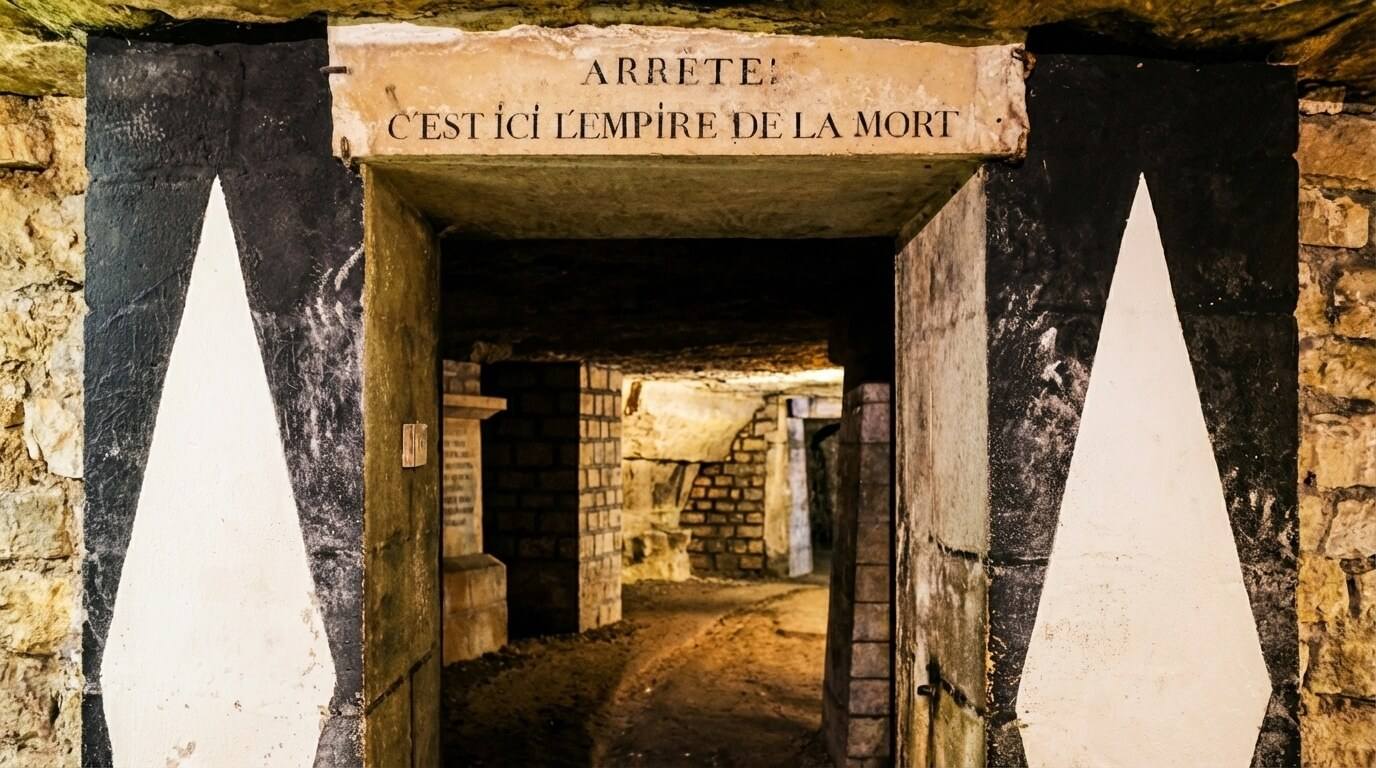
The entrance to the ossuary proper carries the most quoted line underground. Carved above the doorway, it reads “Arrête ! C'est ici l'empire de la mort”, roughly “Stop! This is the empire of death”.
Before that doorway you walk a long stretch of bare quarry. After it the bones begin and barely stop until close to the exit. Our step-by-step walk through the route shows where each part falls.
The ossuary has received visitors from the early 1800s, though visits were occasional at first. Over time it became one of the city's museums, run today by Paris Musées.
Hear the quarry story from a guide
Walks tells the history over about 2 hours in groups of up to 14, with special areas such as the underground chapel and the quarryman's carvings.
A name that plays on hell
The square above the entrance has a history of its own. The old toll gate was the Barrière d'Enfer, and Enfer means hell in French, a fitting name for a door to the dead.
Later the square was renamed after Colonel Denfert-Rochereau, a hero of the siege of Belfort, and the new name sounds almost the same. The Wikipedia article on Place Denfert-Rochereau tells the rest of the square's story.
Why the story lands better with a guide
The self-guided ticket from ~$42 gets you in with an audio guide, and it covers the basics well enough. It cannot answer a question about one particular plaque, or about a carving you spotted on the wall.
Walks' special access tour from ~$155 is the cheapest guided way to hear the history. It holds 4.7 from 1,000+ reviews on GetYourGuide and opens areas closed to ordinary visitors.
Memories France, our pick, keeps groups to seven at most behind the locked gates. How the two compare is set out in our guide to group sizes and on the price page. Our ticket versus live guide page weighs the ticket against both.
Families may want our notes on bringing children into an ossuary before booking. The history lands differently on a ten-year-old than on an adult.